Receiving a brain tumor diagnosis is an overwhelming experience, and the natural instinct for most patients is to find a surgeon and schedule an operation as quickly as possible. However, when a tumor is located in the cerebellum, rushing into the first available treatment plan can be a costly mistake.
Cerebellar tumors present a highly unique and complex challenge in neurosurgery. Because of where they are located, the standard medical advice of “just cut it out” rarely applies. The reality of managing these tumors is nuanced: the critical decision is rarely a simple choice between operating or not operating. Instead, it is a careful calculation of how to approach the tumor, when to intervene, and how much tissue can safely be removed.
1. The Anatomy of Risk: Why Cerebellar Tumors Are Different
To understand why decision-making is so complex, it helps to understand the anatomy of the back of the brain. The cerebellum sits in a region called the posterior fossa. This is a small, tightly enclosed space at the base of the skull.
While the upper parts of the brain have some room to accommodate a growing mass, the posterior fossa has almost no flexibility. Even a very small tumor in this zone can quickly become dangerous due to its immediate neighbors:
- The Cerebellum itself: Responsible for your balance, spatial orientation, walking coordination, and fine motor skills (like writing or buttoning a shirt).
- The Brainstem: The ultimate “control center” for life-sustaining functions. It sits directly in front of the cerebellum and controls your breathing, heart rate, blood pressure, and the cranial nerves responsible for swallowing, facial movement, and eye tracking.
- The Fourth Ventricle: A critical highway for cerebrospinal fluid (CSF)—the fluid that cushions your brain and spinal cord.
Because space is so limited, a cerebellar tumor doesn’t just threaten coordination; it can compress the brainstem or completely block the flow of CSF, leading to a dangerous buildup of pressure inside the skull known as hydrocephalus.
2. The Key Factors Shifting the Surgical Strategy
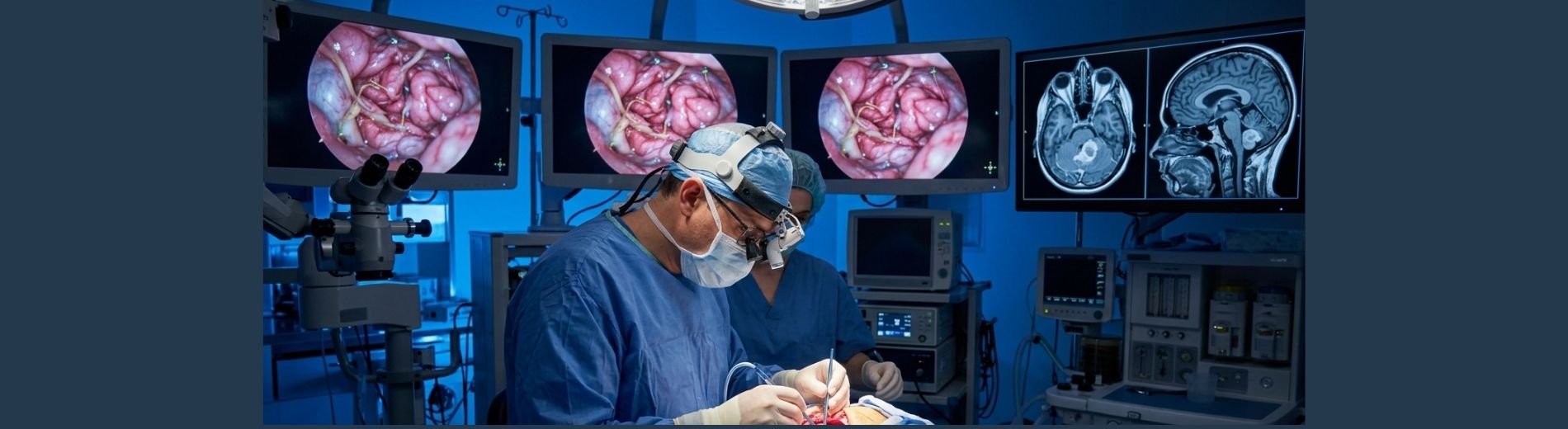
When a neurosurgical team reviews your MRI scans, they aren’t just looking at the size of the tumor. They are assessing several critical variables that dictate the safety and timing of a procedure.
A. The Presence and Severity of Hydrocephalus
If a tumor is pressing on the fourth ventricle, CSF begins to back up like water behind a dam. This causes rapid, life-threatening pressure within the skull.
- The Decision Pivot: If severe hydrocephalus is present, the urgency of the case skyrockets. A surgeon may decide that they cannot safely remove the tumor immediately without first relieving the pressure. This might require a temporary external drain (EVD) or a permanent internal bypass called a shunt before the actual tumor surgery takes place.
B. Tumor Borders: Well-Defined vs. Infiltrative
Different types of tumors behave differently in brain tissue.
- Benign or Well-Defined Tumors: (Like pilocytic astrocytomas or meningiomas) often have clear, distinct borders. They push against the cerebellum rather than growing into it, making them much safer to separate and remove completely.
- Infiltrative Tumors: (Like medulloblastomas or high-grade gliomas) weave themselves directly into healthy brain tissue.
- The Decision Pivot: If a tumor is infiltrative, trying to cut out 100% of it means permanently destroying the healthy brain tissue it has tangled with.
C. Surgical Accessibility and “Real Estate”
Location matters immensely within the posterior fossa. A tumor located in the outer edges (the cerebellar hemispheres) is much easier and safer to reach than a tumor located in the center (the midline or vermis), or one that is directly adherent to the brainstem. The depth of the tumor dictates the “surgical corridor”—the physical path the surgeon must take through healthy tissue to reach the target.
D. The Patient’s Baseline Neurological Condition
Surgery is a physical trauma. A patient who is actively walking and talking, despite their tumor, has a different risk profile than a patient who is already suffering from profound neurological deficits, severe weakness, or lethargy due to high intracranial pressure. The patient’s current state determines whether a surgeon recommends immediate, aggressive action or a staged, gentler approach to give the brain time to stabilize.
3. The Dangerous Misconception: “Complete Removal at Any Cost”
In many areas of cancer care, the goal is total eradication. In posterior fossa surgery, however, an aggressive “get it all out” mindset can result in devastating, irreversible complications.
If a surgeon prioritizes total removal over the preservation of vital anatomy, the patient may wake up with permanent neurological injuries, including:
- Severe Ataxia: An inability to coordinate voluntary movements, leaving the patient unable to walk or feed themselves independently.
- Cranial Nerve Deficits: Resulting in double vision, facial paralysis, or an inability to swallow safely, which requires a permanent feeding tube.
- Posterior Fossa Syndrome: A complex post-surgical condition (more common in children but seen in adults) that can cause temporary or permanent loss of speech, emotional changes, and severe motor delays.
The Golden Rule of Neuro-Oncology: The goal of cerebellar surgery is maximum safe resection, not maximal resection. Leaving a small, stubborn piece of tumor attached to a critical nerve or the brainstem is often the far superior, safer decision, as that remaining piece can often be treated later with targeted radiation.
4. When the Right Choice Isn’t Surgery
A common mistake patients make is assuming that a brain tumor diagnosis automatically means heading straight to the operating room. Depending on the tumor’s characteristics, several alternative or combination strategies may actually provide a better quality of life:
- Active Surveillance (“Watch and Wait”): For small, slow-growing, or incidentally discovered tumors (like small acoustic neuromas or benign meningiomas) in patients with minimal symptoms, monitoring the tumor with regular MRIs is often far safer than risking a major operation.
- Stereotactic Radiosurgery (SRS): Technologies like Gamma Knife or CyberKnife deliver highly concentrated, precise beams of radiation directly to the tumor without opening the skull. This is frequently the preferred choice for deep-seated, small, well-defined tumors, or for treating residual tumor pieces left behind after a safe partial surgery.
- Staged Treatment Strategies: Sometimes, the safest path involves a combination: a limited surgery to safely remove the bulk of the tumor and relieve pressure, followed by radiation or chemotherapy to clean up the rest.
5. Why a Second Opinion Can Completely Change Your Outcome
Because cerebellar tumor surgery is exceptionally technique-sensitive and requires immense judgment, different neurosurgeons will look at the exact same MRI scan and propose vastly different plans.
[Image comparing surgical access approaches to the posterior fossa]
When you seek a second opinion from a specialized skull-base or posterior fossa neurosurgeon, you may discover variations in:
- The Surgical Approach: One surgeon may plan an approach that requires retracting (pushing aside) critical brain tissue, while a more specialized surgeon might utilize a different angle or corridor that minimizes brain manipulation.
- The Timing: A specialist might recognize that treating your hydrocephalus first will make the ultimate tumor removal significantly safer a week later, rather than tackling both at once.
- The Extent of Resection: A conservative, highly experienced surgeon might explicitly state, “I only intend to remove 85% of this tumor because the remaining 15% is fused to your brainstem,” protecting your ability to walk and talk after surgery.
Conclusion
When dealing with a cerebellar tumor, the primary threat to your future quality of life isn’t always the tumor itself—it is the decision pathway chosen to treat it.
Before consenting to a complex posterior fossa procedure, empower yourself by asking your surgical team tough questions about boundaries, risks to adjacent structures, and the management of brain pressure. Remember: taking an extra few days to seek a comprehensive second opinion isn’t a delay in care; it is the first and most critical step toward ensuring you have the right plan, not just the first one.
Are you or a loved one navigating a complex brain tumor diagnosis? Contact Averia Health today to connect with leading neurosurgical specialists who can help you evaluate your options and map out the safest path forward.