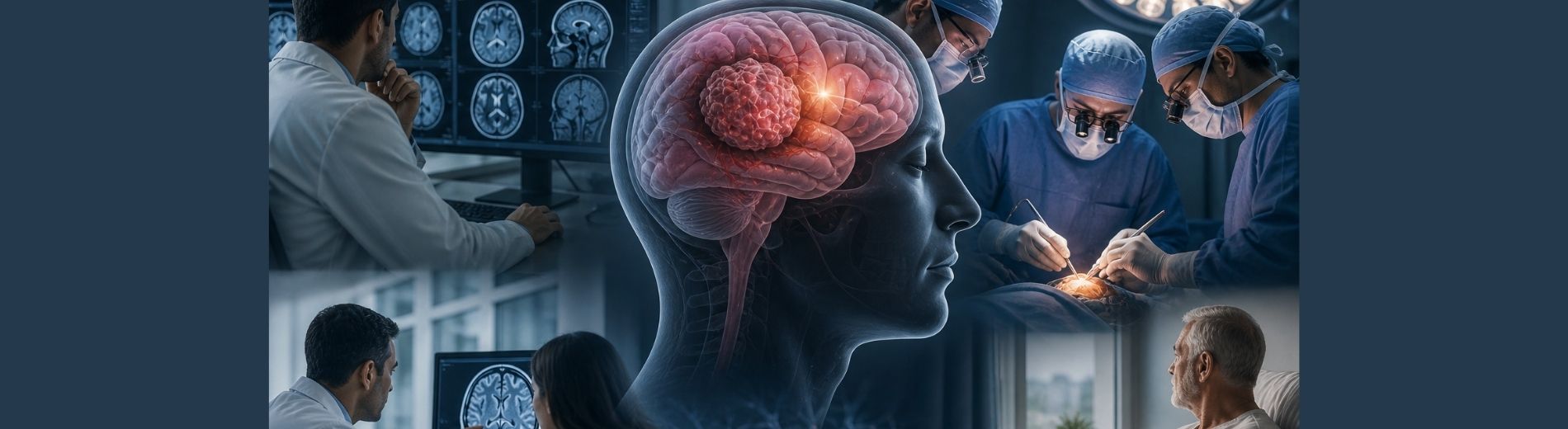
Hearing the words “brain tumor” immediately raises one question:
Will I need surgery?
The answer is not always straightforward.
Brain tumor management is not a one-size-fits-all process. It is a carefully structured decision pathway based on tumor type, size, location, and patient condition.
Understanding that pathway removes fear—and replaces it with clarity.
1. Diagnosis: More Than Just Finding a Tumor
Diagnosis begins with imaging—usually MRI.
But identifying a tumor is only the first step.
Key questions include:
- Is the tumor benign or malignant?
- Where is it located?
- Is it affecting critical brain functions?
- How fast is it growing?
In many cases, a biopsy may be required to confirm the diagnosis before any treatment decision is made.
2. Do All Brain Tumors Require Surgery?
No.
This is one of the most important misconceptions.
Surgery is recommended when:
- The tumor is causing pressure or symptoms
- It is accessible and removable
- Tissue diagnosis is necessary
- There is a risk of progression
Surgery may NOT be needed when:
- The tumor is small and asymptomatic
- It is located in high-risk or inoperable areas
- It is slow-growing and can be monitored
- Non-surgical treatments are more effective
3. The Goal of Brain Tumor Surgery
Surgery is not always about “removing everything.”
The goal can be:
- Complete removal (if safe)
- Partial removal to reduce pressure
- Obtaining tissue for diagnosis
The most important principle:
Maximum safe resection
Meaning: remove as much as possible without damaging critical brain function.
4. Risks and Considerations
Brain surgery is highly precise—but not risk-free.
Potential risks include:
- Neurological deficits (speech, movement, vision)
- Bleeding or infection
- Swelling (edema)
- Need for further treatment
This is where surgeon subspecialization becomes critical.
5. Recovery: What Patients Should Expect
Recovery varies significantly depending on:
- Tumor location
- Surgery complexity
- Patient health
Typical recovery phases:
- Hospital stay: a few days to a week
- Early recovery: fatigue, mild symptoms
- Rehabilitation: if needed (speech/physical therapy)
- Return to normal life: weeks to months
6. The Role of a Second Opinion
For complex brain tumors, a second opinion can:
- Confirm the necessity of surgery
- Offer alternative approaches
- Reduce uncertainty
Conclusion
Brain tumor surgery is not just a procedure.
It is a decision pathway.
And the quality of that decision determines everything that follows.